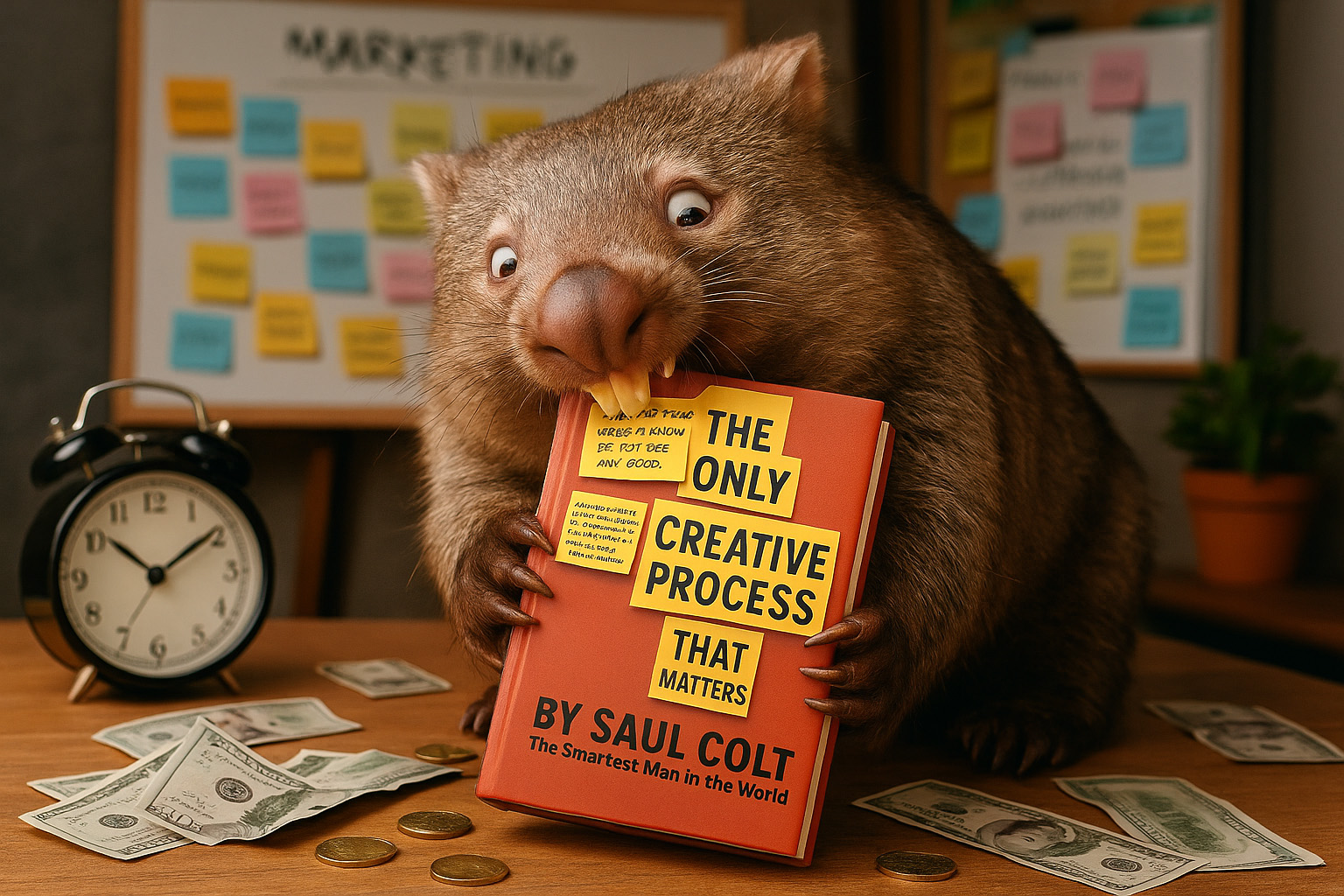
The Wombat Paradox
After being featured as a live commentator in the audiobook recording of one of the chapters of Saul Colt’s book, The Only Creative Process That Matters: Finding Ideas and Knowing If They Are Any Good From The Smartest Man In The World, I was, of course, intrigued—and ended up reading the entire thing. Funny enough, I hadn’t actually read ANY of the book before Saul read Chapter 4 to me live during our recording session. So the whole thing came as a pleasant surprise, and I got to appreciate his intellect and wit firsthand, with no preconceived notions.
One of the standout ideas in the book is Saul’s WoMBAT framework, and I absolutely love it. That said, I couldn’t help but chuckle—because for years, I’ve known WOMBAT as an acronym for “Waste of Money, Brains, and Time.” Ironically, Saul’s WoMBAT is the exact opposite: a tool designed to extract the boldest, smartest, most high-impact ideas from even the messiest creative chaos.
WoMBAT ("What Might Be All The…"), as conceived by Saul Colt, is specifically designed as a structured brainstorming tool. It encourages teams to explore every possible idea, good, bad, absurd, brilliant, expensive, cheap—without prematurely dismissing any possibility. This approach theoretically maximizes creativity and opens doors to extraordinary, memorable, and differentiated ideas.
However, here's the catch:
- If poorly managed, WoMBAT can descend into a prolonged, directionless brainstorming session, creating tons of ideas without actionable outcomes.
- Without skilled moderation (from Saul or another creative genius) or a clearly defined objective, WoMBAT sessions might yield overly extravagant or impractical concepts.
- Teams might spend disproportionate resources exploring unrealistic or irrelevant ideas, causing it to feel like an inefficient use of time and resources.
In other words, improperly executed, a WoMBAT session indeed can become a WOMBAT:
- Waste of money (paying for resources or expensive consultants)
- Waste of brains (talented people chasing unrealistic ideas)
- Waste of time (long meetings without concrete results)
How to avoid WoMBAT becoming a WOMBAT:
(Yes, Saul covers most of this in his book too, but I thought I would point it out here.)
- Clear objectives: Clearly define the business problem or opportunity you’re addressing.
- Structured timing: Limit brainstorming sessions and have clearly defined milestones to move from broad ideas to actionable ones quickly.
- Facilitation: An experienced moderator should guide the process, ensuring alignment with business objectives.
- Honor the chaos: WoMBAT isn’t about picking winners. It’s about building an absurdly large pile of potential. The magic happens later.
Bottom Line:
WoMBAT is a powerful framework for idea generation...but it’s not a free-for-all. Like any creative process, it needs structure, purpose, and a skilled hand at the helm. When run well, it delivers gold. When run poorly, it might just earn its namesake.
I highly recommend Saul’s book. It’s a quick, sharp, and entertaining read with real insight into the creative process—and the courage it takes to chase bold ideas. As I’ve always said: Go big or go home. Saul’s framework gives you permission to do exactly that.