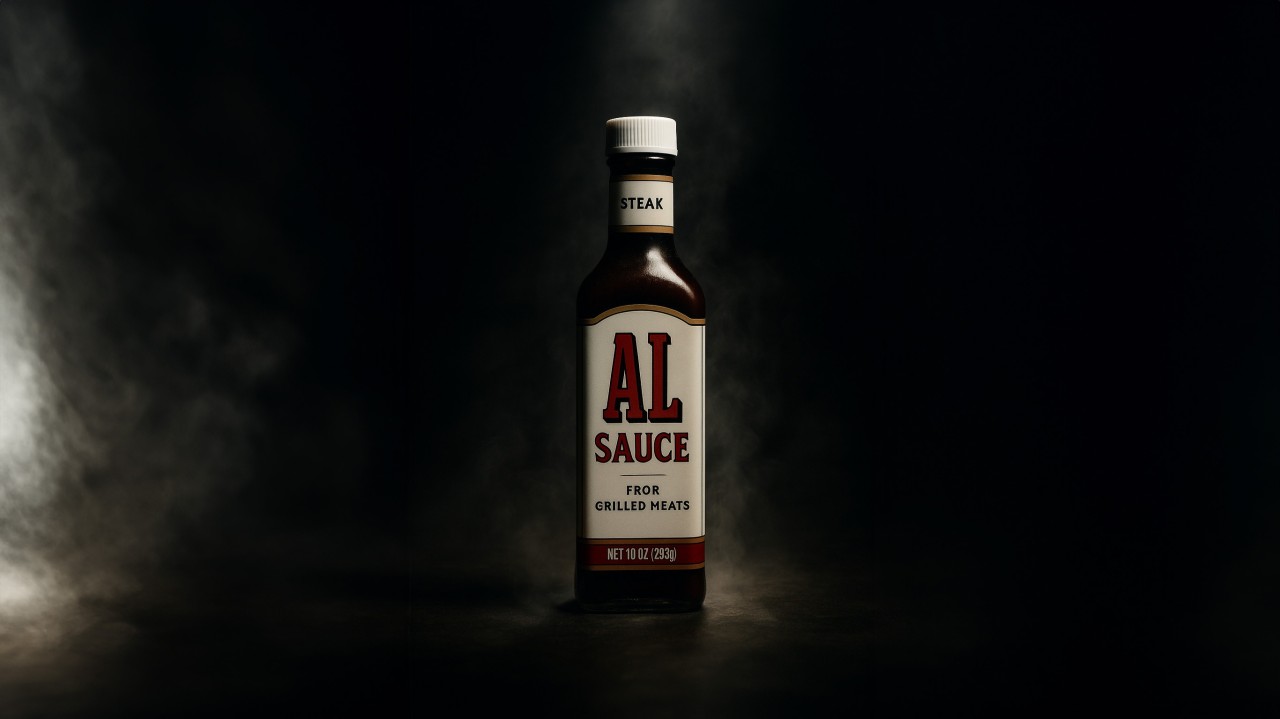
AL Sauce and the Paths Our Brands Take Without Us
Years ago, my wife—an immigrant who speaks three languages, two of which do not use the Latin alphabet—once referred to A1 Steak Sauce as “AL Sauce.”
It was a totally innocent mix-up. Her eyes weren’t yet trained to distinguish between a capital “I,” a lowercase “l,” and the number “1.” But something about it was just perfect. From that day forward, our family affectionately called it AL Sauce. And for 15 years, it stuck.
Then, just a few nights ago, she opened the fridge, paused mid-reach, and asked:
“Do you want the A.I. Sauce?”
She was serious. She was also tired. And her brain just read what it saw—two letters that, in 2025, carry more cultural weight than ever before.
We laughed. A lot.
But it also made me think.
The Brand You Build vs. The Brand They See
As someone who’s worked in branding and marketing for over two decades, I’ve learned a hard truth:
Your brand is not what you say it is. It’s what people say it is. It's what feels right to them.
Brands live in people's minds. They’re built through interactions, impressions, nicknames, habits, and even innocent mistakes. A brand is fundamentally about the feeling it evokes in people. It's the sum of all the associations, emotions, and experiences a person has with a product, service, or company.
FedEx figured this out early. Nobody said “Federal Express,” no matter how much they spent on branding. Eventually, they stopped fighting it and embraced the name people were already using.
My father had a similar experience when he founded The F.E.N.G. (The Financial Executives Networking Group), a professional organization with tens of thousands of members worldwide. From the beginning, he was adamant that people say each letter and include the definite article: “The F.E.N.G.” He wanted the acronym to feel deliberate, reinforcing both the professionalism of the group and its web domain: TheFENG.org.
But over the years, members organically started calling it “FENG.” They said it like a word. Not an acronym. He hated it. It didn't explain what the organization did. It didn't speak to finance, executives, or networking. And he was especially sour because it sounded a bit like “fang,” and he was no vampire. But eventually, even he had to admit:
That’s what people were already calling it. And that’s what stuck.
Desire Paths and the Brand You Can’t Control
This is the branding equivalent of what designers, architects, and city planners call a “desire path.”
It’s that trail that cuts diagonally across a field, worn into the grass by countless footsteps, choosing the most natural, efficient route over the one officially paved.
Good designers observe those paths and build around them. Great designers embrace them.
A well-known example is The Oval at Ohio State University. Instead of forcing students to follow a rigid grid of sidewalks, the university waited. They observed. As students walked their preferred routes across the grassy expanse, desire paths formed. They were beaten down into the dirt and sand over time. Then, only after those patterns emerged, the university paved those very paths, preserving the routes that students had collectively chosen. In other words, the path was not dictated to them. It was revealed by them.

This isn’t just a branding or architectural phenomenon...it’s human nature. People get nicknames all the time, too. This is, in essence, a brand change. Some embrace them. Some can’t wait to shake them off.
I knew a guy named “Slim” who was anything but. (Maybe the name made him feel lighter...) In my own family, the nickname “Bud” gets passed around like a family heirloom. I embraced it. My sister? Not so much—she couldn’t wait to drop it the moment she got married. (She didn't embrace the brand.) Oddly enough, there was once a guy who tried to get people to call me “Heineken” (He was an innovator trying to put his own spin on the obvious competitive brand connection). Thankfully, that one didn't stick.
The point is: nicknames are part of your personal brand and stick when they feel right to others. Not because we approve of them, but because they capture something memorable, funny, or familiar in those observing and interacting with us. Corporate brands work the same way.
Even celebrities have had to adapt to this reality:
- Dwayne “The Rock” Johnson originally hated being typecast by his wrestling nickname, but it helped make him a household name.
- Marshall Mathers chose Eminem. Most fans run with it, but some call him Slim Shady.
- Aubrey Drake Graham goes almost exclusively by Drake now, a middle name turned brand empire.
- Jennifer Lopez embraced J.Lo after the media coined it, and turned it into a lifestyle brand.
Once the world decides what to call you… you can fight it, or you can own it. Because the truth is, those names often stick for a reason.
The best brands pay attention to what people call them, how people use them, and where those mental “shortcuts” are forming.
Sometimes, what emerges is simpler. Sometimes it’s weirder. Sometimes it even feels off-brand… until you realize it’s actually perfectly on-brand.
Because that’s how the world wants to relate to you.
AL Sauce, AI Sauce, and Listening to the World
So yeah, A1 Sauce probably won’t rebrand to AL Sauce (or A.I. Sauce) anytime soon.
But maybe they should. 😉
The real magic of branding is knowing when to lead and when to listen.
So if your audience has renamed you, redefined you, or rerouted your message—don’t correct them. Follow the path they’ve already cleared. And then pave it.
Maybe… just maybe… that’s the brand you were meant to be all along.