Intentional Algorithmic Control: Reclaiming Agency in a Digital World
There was a Saturday Night Live (SNL) skit with John Lovitz in the 1980's titled, “You can pick your friends, you can pick your nose, but you can’t pick your friends' noses.” It’s a silly, crude quote, but what it's saying, is actually pretty deep: You are in control of who you associate with, and what comes out of you, but not what comes out of other people (not even your friends).
This article comes from the perspective of someone who works in digital spaces, marketing, media, and technology. But not only that, I am also a person who lives in this world the same way everyone else does. I open social media in the morning. I scroll at night. I get pulled into conversations and sometimes react before thinking. I have, on many occasions, caught myself engaging in something that wasn’t actually good for my time, my energy, or my mindset.
I’m not above it. And that’s exactly why I’ve become so interested in understanding what’s really happening beneath the surface of what we casually call “social media.”
Critics are quick to call out the flaws in social media and point fingers at the evil corporations profiting. But this isn’t primarily a technology problem. It’s a human one.
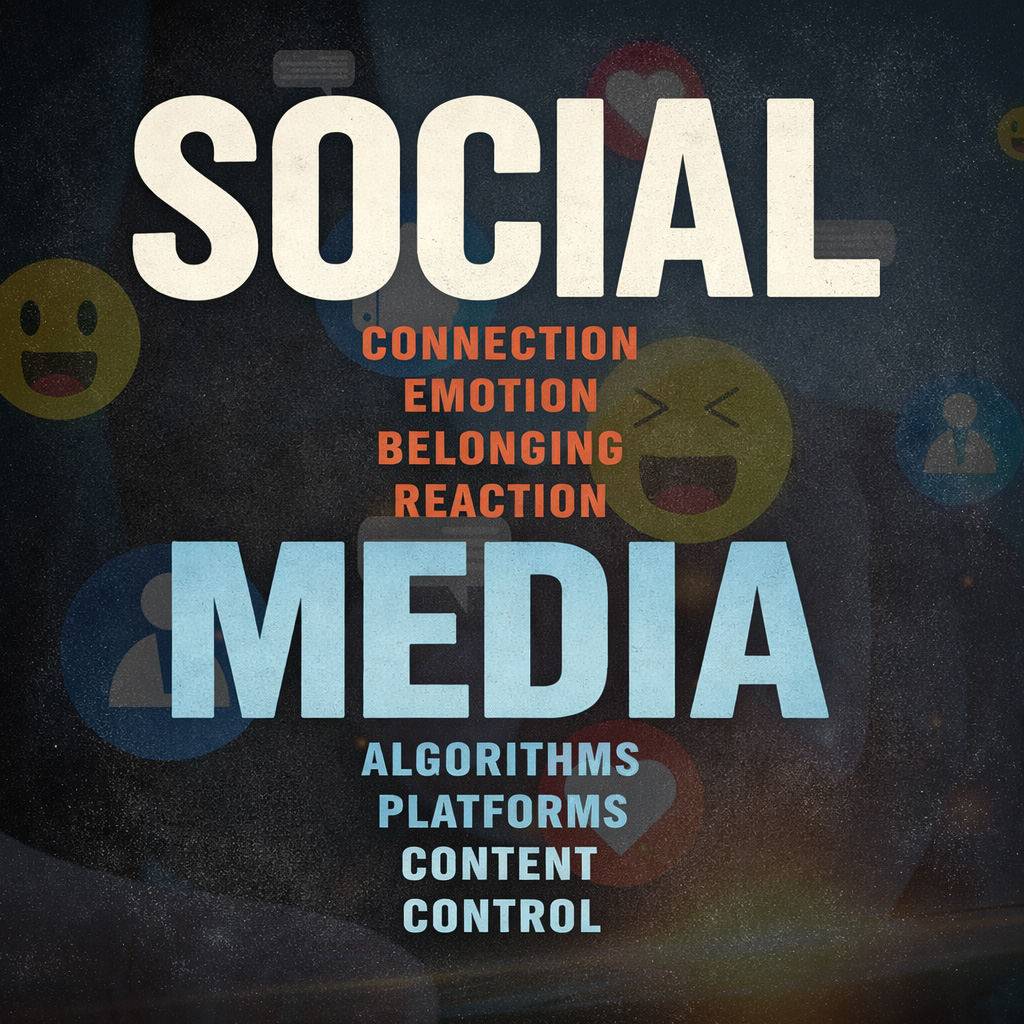
We talk a lot about “the algorithm” as if it’s some mysterious external force acting upon us, shaping our thoughts and behaviors from the outside. But social media is social before it is anything else. It is built on human interaction: emotion, curiosity, insecurity, status, belonging, disagreement, and attention. The platforms didn’t invent those things. They learned how to measure them, reward them, amplify them, and profit from them.
Every click, every comment, every moment of attention becomes data. That data becomes feedback. That feedback shapes what we see next. Which means that if you don’t manage the social part—your own behavior—you inevitably lose control of the media part—your feed. That isn’t a moral judgment. It’s simply how the system works.
There’s an old joke in technology circles about the “ID10T error.” That’s when an error occurs between the keyboard and the chair. It isn’t the software or the hardware, it’s a person. I’ve come to think that something similar is happening online. We blame platforms. We blame algorithms. We blame “the internet.” But we rarely look honestly at how our own impulses are shaping what comes back to us.
If you can’t regulate your reactions, how do you expect to regulate your data? You’re only ever in control of yourself. And that’s where all of your real power lives.
Jeff Bennington, author of “Becoming Your Greater Purpose,” (a book I narrated on Audible) talks about taking 100% responsibility for your life and your actions. Not as a form of blame, but as a form of empowerment. Because if you don’t take responsibility for yourself, who is responsible for you? Certainly not an app. Certainly not a machine. Certainly not strangers in a comment section. Responsibility falls squarely on your shoulders. Without it, you’re being reactive and not proactive.
There’s a line from the Serenity Prayer that has always resonated with me: accept the things you cannot change, have the courage to change the things you can, and the wisdom to know the difference. That applies almost perfectly to our digital lives.
There are many things we cannot control online. We can’t control what goes viral. We can’t control who is angry today. We can’t control what trends or how platforms optimize. But we can control what we engage with, what we ignore, what we amplify, what we search for, and when we choose to disengage. Wisdom is knowing which is which. Most people exhaust themselves fighting what they cannot change and neglect developing mastery over what they can. (Not to mention the fact that there are a lot of bots out there programmed to argue with humans.)
One of the words that has always struck me as strange in this context is “viral.” Historically, it was a negative term. It meant infection. Disease. Uncontrolled spread. Something dangerous that needed to be contained. Before the internet (yes, the before times) no one ever hoped for something to “go viral.” Now, it’s treated as a badge of honor. That should give us pause.
Virality is not a measure of value. It is a measure of distribution. It tells you that something has spread uncontrollably. It doesn’t tell you whether it was true, thoughtful, healthy, or helpful. Sometimes good things go viral. Often, things go viral because they bypass reflection and trigger the instinctual fight/flight response in our brains: fear, anger, tribalism, outrage. That’s crowd psychology scaled by technology. So when I see something going viral now, my instinct isn’t to immediately accept it. It’s to ask why. What emotional button did this press? What incentive did it exploit? It’s all about mental hygiene.
Another realization changed how I see all of this. When you open your “news feed,” you think you’re seeing what’s new. Most of the time, you’re not. You’re seeing things that are similar to what you engaged with yesterday and the day before. You’re seeing your behavioral history, rearranged. It’s not really a news feed, it's a feedback loop.
Without intentional intervention, yesterday becomes today becomes tomorrow. And you cease to live in the present. You just cycle through the same arguments, triggers, and narratives. People think they’re staying informed. Often, they’re just circling themselves.
This is why discernment matters so much. I’m not advocating for avoiding disagreement. Thoughtful disagreement is invaluable. A healthy debate sharpens thinking and exposes blind spots. It builds understanding with people of different viewpoints. I actively seek it out. That’s how I grow as an individual, intellectually, professionally, and personally. But there is a difference between thoughtful engagement and noise. Dismissal without reading, personal attacks, bad-faith arguments, and combativeness for its own sake isn’t about truth seeking. It’s about status. Feeding it damages both you and the system.
If someone were harassing you in real life, you wouldn’t stand there arguing all day. You’d walk away. Online, we forget that we’re allowed to do that. Disengagement is not a weakness, it’s discernment.
Most hostile engagement is also not random. People rarely attack what they consider irrelevant. They attack what already has their attention. Quite often, that’s about insecurity more than substance and we have the option and ability to not reward it.
Over time, I’ve come to think of this whole practice as Intentional Algorithmic Control (IAC). This is not about manipulation or gaming the system. It is about self-governance of your mental inputs. It’s the practice of consciously shaping your digital environment through intentional behavior. Recognizing that your feed is not something that simply happens to you. It is something you co-create through what you click, comment on, linger on, search for, and who you follow. But also it is made through what you ignore. Lack of engagement is a data point that should NOT be overlooked and its importance should not be minimized.
Most people are editors and don’t know it. IAC is learning to edit deliberately.
Look again at the language we use: doomscrolling, hooked, addicted, viral. These are words of pathology with negative connotations. They’re telling us something. What if instead of doomscrolling, we practiced cultivation? What if instead of waiting for content to go viral, we sought out content that was blossoming? What if instead of following trends, we led with intention? What are we planting? What are we watering? What are we allowing to overgrow?
When you see a piece of content, ask yourself: Is this elevating me? Is this informing me? Is this expanding me? Is this worth my life minutes?
Because that’s what they are. Life minutes.
I want to be honest here. I’m still learning this and working through it. I’m only human. But when I catch myself slipping, I attempt to right the course. This isn’t about perfection. It’s about awareness, progress, and intentionality.
Pink Floyd so eloquently said, “All you do and all you see is all your life will ever be.” That is the heart of it: Attention is life. Where you place it is who you become. If you let machines and mobs decide that for you, you are a sheep outsourcing your humanity to the herd. If you take responsibility, you reclaim it.
That is empowerment.
So, this is my invitation to notice, question, and choose your reality. Practice Intentional Algorithmic Control. Take full responsibility for your digital life. Accept what you cannot change, master what you can, and seek wisdom in between.
I’m not suggesting you go full Luddite and stand above or outside the system.
I’m inviting you to live consciously inside it.
Because you are worth more than your impulses.
And your life is worth more than an unexamined feed.